
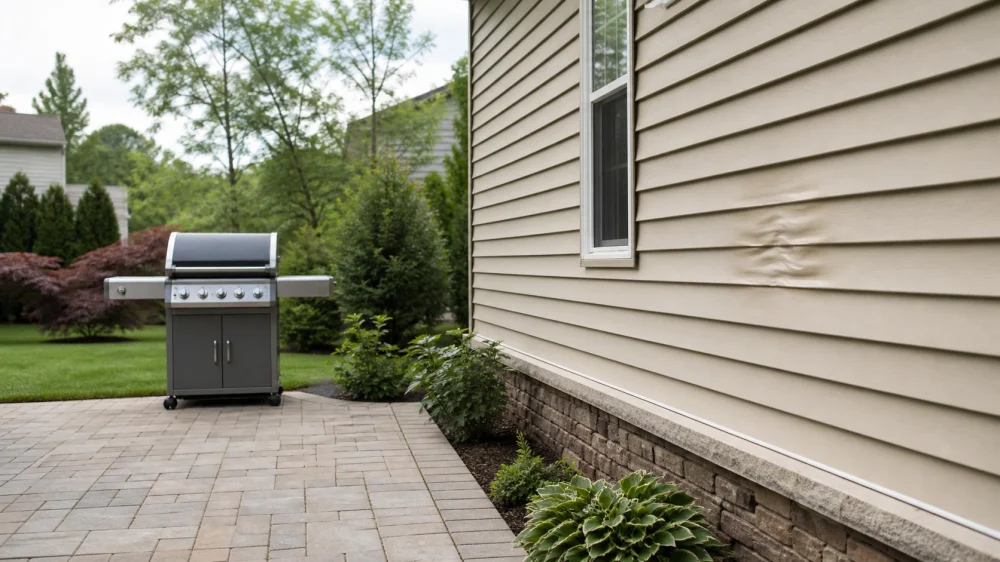
Grill Heat Near Vinyl Siding: Move It Before You Cook
On this page
- Quick answer
- Create a real safety zone
- Recognize heat and fire damage
- Set up before lighting
- Supervise every cooking session
- What to do after siding is damaged
- Plan a documented siding repair
- Important limitations
- Grill and siding checklist
- Frequently asked questions
- Sources and evidence notes
- Conclusion and next steps
Quick answer
Move an outdoor grill away from vinyl siding, deck rails, eaves, open windows, doors, and overhanging branches before lighting it. The U.S. Fire Administration recommends at least 3 feet from siding, deck railings, and eaves, plus a 3-foot safety zone for children and pets. Use the grill outdoors in an open location, follow its manual, and never leave it unattended.
If siding has softened, warped, melted, scorched, or pulled away, stop using that location. Once the grill is cold and the area is safe, photograph the damage and have the wall assembly checked for heat effects beyond the visible panel.
Loudoun Professional Roofing
SterlingLoudoun CountyVirginia
20296 Youngs Cliff Rd, Sterling, VA 20165, USA
Create a real safety zone
Measure from the hottest and widest parts of the grill, not only from its wheels. Account for an open lid, side burner, grease tray, exhaust openings, and the path used to move around it. Three feet is USFA’s general minimum; the grill manufacturer, fuel supplier, property rules, fire code, or combustible surroundings may require more.
Do not use or store a grill on a porch or balcony where prohibited. USFA advises against grill use or storage on porches and balconies. Never move a lit grill closer to the wall to escape rain or wind.
Affordable Panhandle Gutters ,
3992 Delisa Ave, Panama City, FL 32404, USA
Recognize heat and fire damage
Vinyl siding can deform from radiant heat before flames touch it. Look for waviness, ripples, glossy or dull patches, shrinking, buckled seams, discolored panels, open joints, and distorted trim. Smoke marks, char, blistered housewrap, brittle foam, melted fixtures, or odor can indicate deeper involvement.
Reflected sunlight from some energy-efficient windows can also distort vinyl, so document the time, grill position, weather, and shape of the affected area before assuming a cause. A qualified inspection can distinguish installation movement, solar reflection, and direct heat exposure.
Set up before lighting
- Choose a stable, level, noncombustible location outdoors.
- Measure clearance from siding, rails, eaves, branches, and openings.
- Keep the grill out of exit paths and away from play areas.
- Check hoses, connections, grease trays, and manufacturer-required clearances.
- Open a gas-grill lid before lighting, as USFA advises.
- Keep a phone and suitable fire-response equipment accessible without blocking escape.
If fuel is smelled, the burner fails to light, or the flame behaves abnormally, shut the grill down according to its manual and have it serviced. Do not search for a gas leak with a flame.
Supervise every cooking session
Stay with the grill while it is lit and keep children and pets outside the safety zone. Control grease buildup and flare-ups according to the appliance instructions. Do not wear loose clothing or place towels, packaging, or furniture within the heat zone.
If fire spreads beyond the grill, threatens the home, or cannot be controlled safely, alert others, move away, and call 911. Do not risk burns or block the exit while trying to save siding.
What to do after siding is damaged
Turn off the appliance according to its manual if that can be done safely, then keep the location unused until the cause is addressed. Photograph the grill position and distances before moving it, unless leaving it in place creates a hazard. Record the fuel type, weather, cooking duration, observed flames, and when the siding changed.
From ground level, inspect the wall, soffit, trim, window, receptacles, and penetrations. For smoke, charring, persistent heat, gas odor, electrical damage, or possible fire inside the wall, evacuate and call emergency services.
Plan a documented siding repair
A siding contractor should identify the product profile, color, exposure, locking pattern, and damaged area. Ask whether the weather-resistive barrier, sheathing, insulation, window flashing, electrical boxes, or framing need inspection. Replacing only the most visibly warped panel may leave hidden damage or an incomplete color match.
Request a written scope showing removal limits, substrate findings, compatible replacement materials, flashing and fastening details, and disposal. Keep before-and-after photos and the product information for future repairs.
Important limitations
Clearance varies by grill model and installation. Built-in outdoor kitchens require a listed design, compatible noncombustible construction, ventilation, and fuel connections. A heat shield or cement board does not automatically make an unsafe placement compliant and should not replace manufacturer clearances.
Vinyl, fiber cement, wood, composite, insulated siding, and trim respond differently to heat. Local fire and building rules and lease or association restrictions may be stricter than general guidance.
Grill and siding checklist
- Use the grill outdoors in an allowed location.
- Keep at least 3 feet from siding, rails, and eaves.
- Follow any greater manufacturer clearance.
- Maintain a 3-foot child and pet safety zone.
- Open the gas-grill lid before lighting.
- Never leave a lit grill unattended.
- Stop using any location that scorches or deforms siding.
- Document damage and inspect hidden wall components.
- Repair the siding only after the heat source is relocated.
Frequently asked questions
Is 3 feet always enough?
It is USFA’s general minimum. Use a greater distance when the manual, local code, property rules, wind, or nearby combustibles require it.
Can I grill under an eave?
USFA says to keep grills away from eaves. Choose a fully outdoor, open location that meets all clearances.
Will a grill melt vinyl without a fire?
Yes. Radiant and exhaust heat can deform some siding even without direct flame contact.
Can I install a shield behind the grill?
Do not improvise one as a substitute for clearance. A built-in design needs compatible, listed construction and local approval where required.
Should I replace only the warped panel?
First inspect the substrate, barrier, trim, and nearby components for hidden heat damage and confirm a compatible replacement.
What if the siding was already rippled?
Document timing, sunlight, temperature, and grill position. Installation stress and reflected solar heat are other possible causes.
Sources and evidence notes
The U.S. Fire Administration outdoor fire-safety page advises placing a grill well away from siding, rails, eaves, and branches, maintaining a 3-foot safety zone, opening a gas-grill lid before lighting, and never leaving a lit grill unattended. Its 3-foot grill-zone pictograph gives the specific minimum from siding, rails, and eaves.
Product instructions and locally adopted requirements determine the actual placement and repair details for a particular property.
Conclusion and next steps
Relocate the grill before the next use, measure the full heat and movement zone, and follow any clearance greater than USFA’s 3-foot minimum. If siding has changed shape or color, stop using that location, document the condition, and inspect the wall assembly before repairing the visible panel.
 Mr. Happy House of The Woodlands | Roofing, Siding, Painting4.0 (88 reviews)
 Window World of Orange County4.0 (58 reviews)
 WRP Construction Inc4.0 (2 reviews)
 Knights masonry & waterproofing5.0 (119 reviews)
 Vidal Painting Corp5.0 (25 reviews)
 Roofing Hands Renovations5.0 (110 reviews)
 How to Choose a Reliable Roofing Contractor Near You with Confidence
 Why Roof Inspections Prevent Unexpected Repairs: A Homeowner’s Guide
 Top 10 Signs Your Roof Needs Immediate Repair: Don’t Delay Roof Repairs
 Should I Repair or Replace My Roof? A Homeowner’s Guide
 Roof & Siding Maintenance Tips for Real Estate Investors
 How Often Should You Replace Your Home's Siding? Key Factors to Consider