
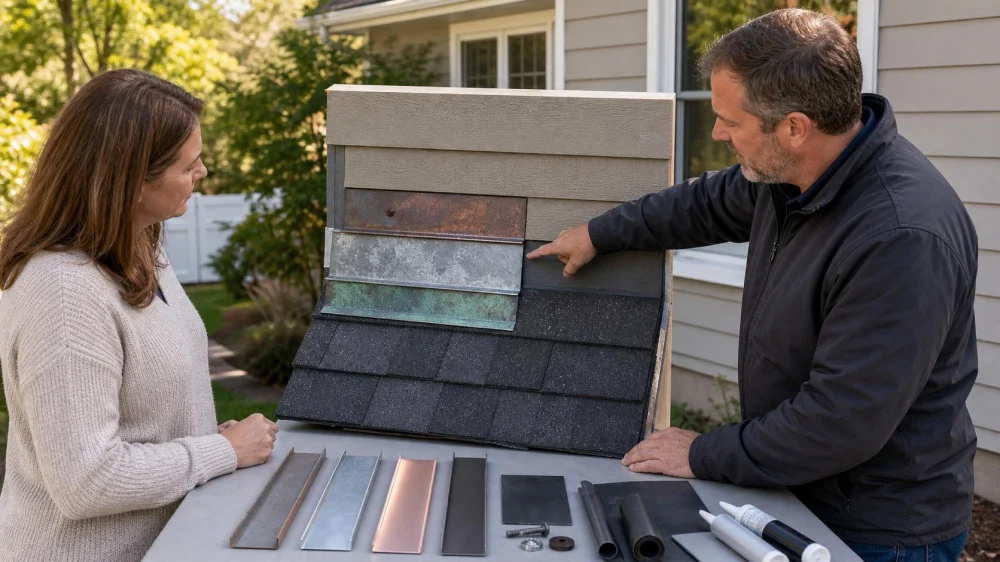
Corroded Roof Flashing: Check Metal Compatibility First
On this page
- Quick answer
- What flashing corrosion can look like
- Where metal flashing is used
- Why roofing metals can corrode
- How metal compatibility affects the detail
- Why water runoff direction matters
- Safe observations from the ground
- What a professional should inspect
- Repair or replacement questions
- What not to coat, scrub, or seal
- Frequently asked questions
- Conclusion and next steps
Quick answer
Roof flashing corrosion can appear as rust, white residue, green staining, pitting, peeling coating, dark streaks, or holes. Photograph it from the ground and note nearby gutters, fasteners, pipes, masonry, treated wood, and runoff paths. Do not scrub, paint, or caulk over the area before inspection. A roofer should identify the metals and exposure, check hidden damage and water entry, and choose compatible replacement materials and fasteners.
Colour alone cannot identify a metal or prove the corrosion mechanism. Coatings, sealants, dirt, oxidation, and runoff deposits can change appearance, so material confirmation may require records or professional testing.

Fortress Roofing & Home Improvement LLC
ChattanoogaHamilton CountyTennessee
1723 Church Rd, Chattanooga, TN 37421, USA
What flashing corrosion can look like
- orange or reddish-brown rust on ferrous material;
- white powdery or crusted residue on some coated or zinc-containing surfaces;
- green or blue-green staining near copper-containing material;
- pits, pinholes, thinning, cracks, or ragged edges;
- blistered, flaking, or chalked protective coating;
- dark streaks below a joint, fastener, or upper metal;
- sealant separating from a rough or oxidized surface.
Deposits can come from a component above, so inspect the water path rather than only the stained spot.
Where metal flashing is used
Flashing manages water at roof edges, valleys, walls, chimneys, skylights, plumbing vents, exhausts, dormers, parapets, gutters, and changes in roof material. Fasteners, counterflashing, drip edges, sealant joints, and protective coatings are part of the detail.
Some flashing is mostly hidden beneath shingles, siding, masonry, or membranes. A small exposed stain may be the visible part of a larger concealed condition.
Why roofing metals can corrode
Corrosion can result from prolonged moisture, trapped debris, salt, acidic or alkaline runoff, damaged coating, incompatible sealant, wet masonry, treated wood chemicals, condensation, industrial pollution, animal waste, or contact between dissimilar metals.
Poor drainage accelerates exposure. Standing water at a low spot, clogged gutter, flat metal bend, buried edge, or sealant dam can keep a surface wet long after rain stops.
How metal compatibility affects the detail
When certain dissimilar metals contact one another in the presence of moisture, electrochemical action can accelerate corrosion of the less resistant metal. Direct contact is not always required if runoff carries dissolved material from an upper metal onto a lower one.
Compatibility also involves fasteners, solder, sealant, membrane, coating, masonry, and preservative-treated wood. A replacement patch made from an unidentified scrap metal can create a new problem even if it initially covers the hole.
Why water runoff direction matters
Map where rain begins and where it travels. Water may flow from a metal roof, copper pipe, masonry cap, HVAC component, solar rack, antenna mount, or upper gutter before crossing the corroded flashing.
Redirecting or isolating incompatible runoff may be necessary in addition to replacing damaged metal. The corrected detail still needs positive drainage and should not trap water behind a coating or sealant bead.
Safe observations from the ground
- Use binoculars or camera zoom from stable ground.
- Photograph the whole roof section and a closer view.
- Note whether staining changes after rain or snowmelt.
- Look for gutter overflow, debris, and downspout discharge.
- Check interior ceilings and walls for corresponding stains.
- Record recent roof, siding, chimney, solar, or gutter work.
Do not touch corroded edges, which can be sharp and weak, or climb to collect a sample.
What a professional should inspect
Ask the roofer or building-envelope professional to identify the flashing and fastener materials, protective coating, adjacent metals and substrates, water route, remaining thickness, holes, seams, attachment, and integration with underlayment or wall barriers.
The inspection should also check roof covering, deck, sheathing, framing, insulation, and interior finishes for moisture damage. When masonry or a chimney is involved, a mason may need to coordinate counterflashing and mortar work.
Repair or replacement questions
- What caused or accelerated the corrosion?
- Which materials are present and how were they confirmed?
- Can the remaining metal provide reliable service?
- What compatible metal, fastener, solder, sealant, and membrane will be used?
- How will dissimilar materials be isolated?
- Will runoff direction or standing water be corrected?
- What roofing, siding, or masonry must be removed and restored?
- How will the completed detail be photographed and warranted?
What not to coat, scrub, or seal
- Do not wire-brush or sand corroded flashing from a ladder.
- Do not apply paint over wet, loose, perforated, or unidentified metal.
- Do not smear roof cement or caulk over drainage seams.
- Do not mix household cleaners, acids, or rust removers on the roof.
- Do not attach a dissimilar scrap-metal patch with random fasteners.
- Do not cover evidence before documenting the water path and hidden condition.
Frequently asked questions
Does rust mean the roof is leaking?
Not always, but corrosion can thin or perforate flashing and may signal persistent moisture. The detail and concealed materials should be checked.
Can roof flashing be painted?
Some compatible intact metals can receive a specified coating after correct preparation. Paint cannot restore lost thickness or fix incompatible materials and trapped water.
Why is there green staining below copper?
Copper-containing runoff can create coloured deposits and may affect other materials. A professional should evaluate the full path and compatibility.
Can sealant isolate two metals?
A designed separator may be part of a compatible detail, but generic surface caulk is not a reliable substitute for correct material selection and drainage.
Conclusion and next steps
Photograph corrosion from the ground, map what lies above it, and record when staining changes. Leave the metal uncoated until a professional identifies the materials, cause, water path, and concealed damage. The repair should use compatible flashing, fasteners, sealants, membranes, and substrates while correcting standing water or incompatible runoff—not simply covering the visible stain.
 Hard Shield Roofing4.0 (17 reviews)
 American Remodeling Enterprises Inc.5.0 (61 reviews)
 Ray and Sons Contracting2.0 (5 reviews)
 HP Commercial Roofing Pro Costa Mesa5.0 (6 reviews)
 Ex Home Solutions, Inc5.0 (111 reviews)
 Erie Home4.0 (204 reviews)
 Should I Repair or Replace My Roof? A Homeowner’s Guide
 How Roof Inspections Help Prevent Expensive Repairs and Damage
 How to Prevent Roof Damage from Weather Changes: Expert Tips
 The Best Roofing Materials for Cold Climates: A Complete Homeowner's Guide
 How Much Does a New Roof Cost in 2025?
 James Hardie vs Vinyl vs Wood Siding: Cost & Durability Comparison