
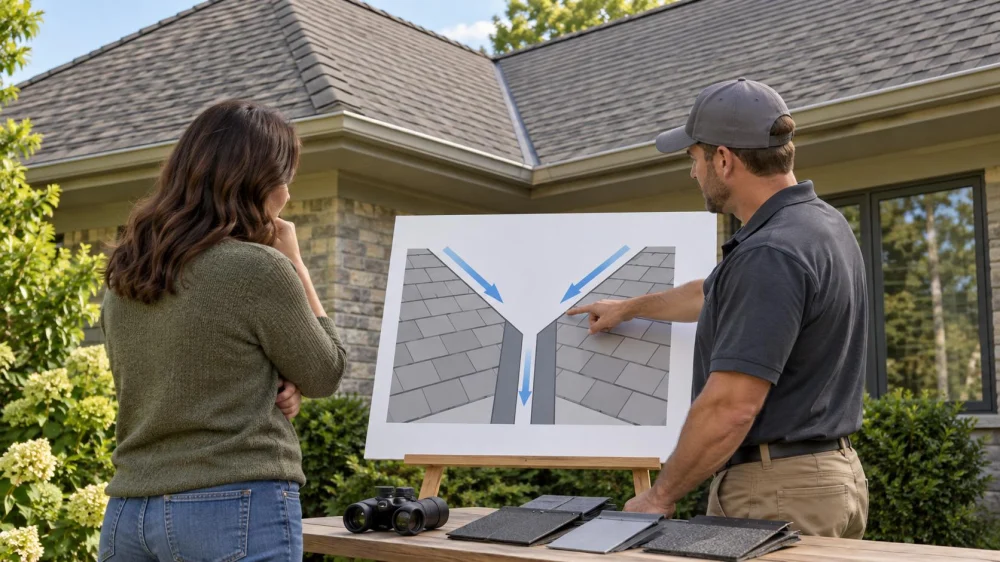
Roof Valley Repair: Define Materials, Debris, and Water Path
On this page
- Quick answer
- Understand why valleys need careful work
- Record clues without climbing
- Identify the installed valley system
- Address debris without damaging the roof
- Define the concealed repair scope
- Review every valley interface
- Compare repair proposals
- Limits and important notes
- Frequently asked questions
- Sources and evidence notes
- Conclusion and next steps
Quick answer
For a roof valley repair, stay off the roof and document leak timing, indoor stains, debris patterns, and visible shingle or flashing changes from safe locations. Ask a qualified roofer to identify the valley type, water path, underlayment, flashing, fastener placement, adjacent roof condition, and why it failed. The written scope should define removal limits, compatible replacement materials, deck repairs, debris handling, weather protection, photos, warranty effects, and how completion will be checked.
Understand why valleys need careful work
A valley concentrates water from two roof slopes, so small defects, poor cuts, misplaced fasteners, debris, ice, or transitions can affect a larger flow. Leaks may also travel along underlayment or framing before appearing indoors.
The visible valley is part of an assembly. Surface sealant or a patch at the stain may not address the entry point or damaged materials beneath it.

Rivera Family Roofing & Remodeling
East HanoverMorris CountyNew Jersey
388 NJ-10, East Hanover, NJ 07936, USA
Record clues without climbing
- Photograph the full valley and roof slopes from the ground.
- Note leaves, branches, displaced shingles, corrosion, gaps, or uneven edges.
- Map indoor stains relative to exterior walls and roof features.
- Record rain direction, intensity, snow, ice, and melt timing.
- Save prior roof, gutter, skylight, solar, and chimney work records.
- Keep people away if material may fall.
Identify the installed valley system
Open metal, woven, closed-cut, and manufacturer-specific valley details manage water differently. Shingle type, slope, climate, roof geometry, and product instructions affect which approach is permitted.
Ask the contractor to name the existing and proposed system and explain compatibility. A detail used on another house or roof product may not be suitable here.
Address debris without damaging the roof
Leaves and needles can slow water and hold moisture, but roof access and cleaning create fall and material-damage risks. Do not climb up, use a pressure washer, scrape shingles, or push tools from a ladder.
Ask the roofer how debris will be removed, whether nearby trees or roof shapes contribute, and whether gutters or diverters affect discharge. Maintenance plans should keep water paths open without trapping debris elsewhere.
Define the concealed repair scope
- State how far shingles and underlayment will be removed.
- Inspect and price deck repair method and allowances.
- Specify membrane, metal, shingle, and fastener compatibility.
- Keep fasteners outside restricted water paths.
- Integrate upper and lower transitions and nearby penetrations.
- Protect the open roof from weather each day.
- Photograph layers before covering them.
Review every valley interface
Leaks can originate where a valley meets a ridge, wall, dormer, chimney, skylight, lower roof, gutter, or eave. Ask how each end and side transition directs water without forcing it under cladding or behind gutters.
Coordinate siding, flashing, gutter, chimney, and solar responsibilities in writing. One trade's boundary should not become an undocumented gap.
Compare repair proposals
Compare diagnosis, removal area, materials, deck allowance, flashing details, waste, access, weather plan, permits, warranty, exclusions, and completion evidence. A low price may describe a surface patch while another quote describes assembly replacement.
Ask what conditions would expand the work and how approval occurs. Do not authorize blank change orders or unspecified sealant as the primary detail.
Limits and important notes
Indoor stain location does not prove the entry point, and a dry-weather inspection may not reproduce an intermittent leak. Water testing, if appropriate, should be planned by professionals to avoid creating damage.
This is general US homeowner guidance, not roofing instruction. Local codes, manufacturer requirements, roof slope and assembly, weather, warranties, and a qualified on-site assessment govern a specific repair.
Frequently asked questions
Can a leaking valley be sealed from the surface?
A temporary measure may sometimes limit water, but lasting repair depends on the failure and assembly. Ask for diagnosis and scope.
Should all valley metal be replaced?
Not universally. Condition, type, compatibility, removal limits, and product details determine the work.
Will cleaning stop the leak?
Debris removal may restore flow but cannot repair damaged flashing, underlayment, shingles, or deck.
Sources and evidence notes
This article applies general steep-slope roofing, valley drainage, flashing, underlayment, contract, fall-prevention, and documentation principles. The roofing manufacturer, codes, qualified contractor, warranty, and actual roof assembly determine the proper detail.
Conclusion and next steps
Photograph the valley and indoor clues from safe locations and record the weather pattern. Ask each roofer to identify the valley system and failure path. Choose a written scope that opens enough of the assembly to correct the cause and documents every concealed layer.


 Martin & Sons Roof Repair4.0 (35 reviews)
 Rivera Family Roofing & Remodeling4.0 (46 reviews)
 Midpoint Roofing5.0 (101 reviews)
 Aura Home Exteriors5.0 (93 reviews)
 Nivelo Construction LLC4.0 (27 reviews)
 Double D Construction4.0 (193 reviews)
 Roof Valley Repair: Define Materials, Debris, and Water Path
 Siding Utility Penetrations: Flashing, Blocks, and Sealant
 Roof Project Neighbor Plan: Debris, Access, and Boundaries
 Roof Vent Replacement: Match Opening and Flashing
 Roof Recurrence Log: Track Weather, Timing, and Clues
 Roof Repair Estimate: Compare Scope, Not Price Alone