
Roofing Material Delivery: Plan Access Before the Truck Arrives
On this page
Quick answer
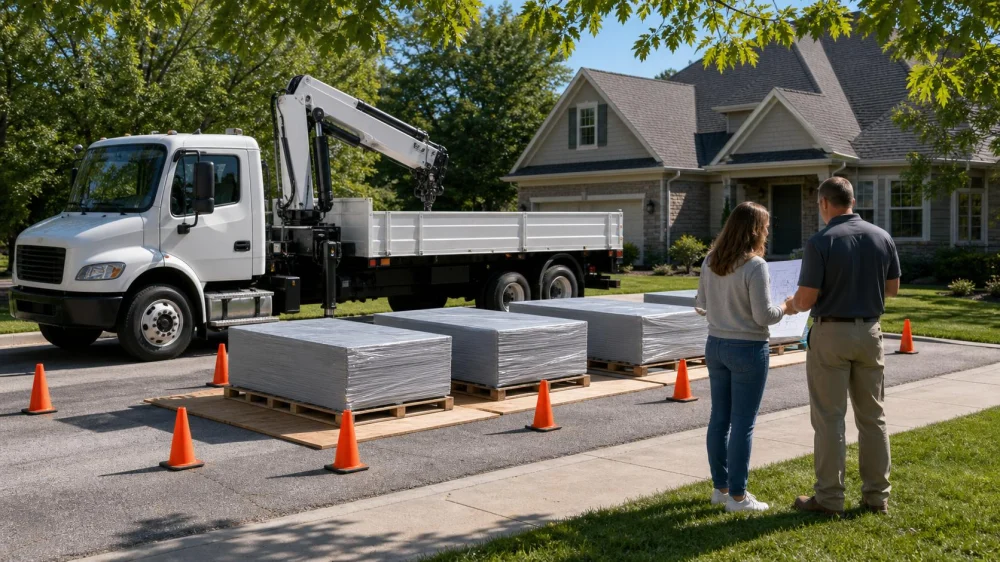
Before roofing materials arrive, ask the contractor who is delivering, what vehicle and unloading equipment will be used, whether products go on the ground or roof, and what clearances and surface capacity are required. Approve a route and staging area that avoids septic components, soft pavement, overhead lines, trees, vehicles, and occupied walkways. Photograph conditions before and after delivery.
The supplier and contractor should decide whether a truck can enter or load the property. A homeowner’s guess about driveway strength or roof loading is not a safe substitute for their assessment.
Confirm the delivery method
Ask for the delivery date and time window, supplier name, truck type, approximate footprint, unloading method, pallet count, and whether a conveyor, boom, forklift, or hand carry is planned. Confirm whether the crew will be present and name the person authorized to redirect or stop placement.
Clarify where shingles or panels, underlayment, flashing, fasteners, vents, siding, trim, and accessories will be staged. Some products need weather protection, flat support, or manufacturer-specific storage. Ask who provides tarps or dunnage and what happens if weather, site access, or an incomplete tear-off makes delivery unsuitable.
Clean Cut Construction
WaynesboroFranklin CountyPennsylvania
4436 Iron Bridge Rd, Waynesboro, PA 17268, USA
Protect people and property
- Move vehicles, bicycles, grills, toys, planters, and loose items before the truck arrives.
- Keep children, pets, residents, customers, and pedestrians out of the delivery and swing zone.
- Identify overhead power or communication lines and do not plan material handling beneath unsafe clearances.
- Mark septic tanks and fields, irrigation, drainage structures, buried utilities, pavers, retaining edges, and soft ground.
- Confirm street parking, lane, sidewalk, permit, or traffic-control requirements with the responsible parties.
- Keep emergency access available and tell the contractor about mobility or medical-access needs.
Do not direct a boom, conveyor, or forklift from beneath a load. The trained operator controls the equipment and must stop if people enter the work zone or conditions change.
Approve placement
Ground staging should be level, stable, drained, protected from traffic, and compatible with the product instructions. Avoid blocking doors, meters, hydrants, vents, drainage paths, or the crew’s debris route. If pallets are placed on a driveway, ask the contractor and supplier how they assessed the surface and how existing cracks or stains will be recorded.
Rooftop loading requires contractor control. Product weight must be distributed only where the roof structure, work sequence, weather, and safety plan allow. Homeowners should not specify a roof location or climb up to inspect it. Ask who confirms structure and load placement and how materials will be secured from sliding or wind.
Receive and document
Take wide photos of the street, curb, lawn, driveway, siding, windows, roof edges, and approved staging area before arrival. During delivery, stay outside the exclusion zone. Record unexpected substitutions, damaged packaging, visible product damage, incorrect color or profile, and placement changes without interrupting the operator unsafely.
After unloading, compare visible labels and quantities with the contractor’s order; do not open sealed products merely to count them. Photograph the final staging, vehicle route, new damage, and leftover packaging. Report discrepancies promptly in writing and let the contractor decide what can be installed. A delivery receipt does not necessarily mean the homeowner accepted product suitability.
Delivery checklist
- Vehicle, equipment, date, and responsible contact confirmed
- Access route and exclusion zone cleared
- Overhead, underground, driveway, septic, and landscape risks disclosed
- Traffic, parking, sidewalk, and emergency access planned
- Ground or rooftop staging approved by responsible professionals
- Weather protection and rescheduling rule confirmed
- Pre-delivery condition photos saved
- Products, packaging, placement, and damage documented
Limitations
Vehicle weights, equipment clearances, pavement capacity, structural loading, traffic rules, and product storage requirements vary. This planning guide cannot approve a delivery route, driveway, or rooftop load. The supplier, contractor, engineer when needed, manufacturer instructions, utility clearances, and local authorities control those decisions.
FAQ
Can the truck park on my driveway?
Only after the responsible supplier and contractor assess the vehicle, surface, route, edges, and buried features. Ask how existing conditions will be recorded.
Should shingles be delivered to the roof?
That is a contractor and supplier decision based on structure, work sequence, equipment, weather, and safety—not a universal preference.
What if materials arrive before the crew?
Use the agreed contact. Do not authorize a new placement unless the responsible contractor confirms it.
Can I stand nearby to guide the operator?
Stay outside the exclusion zone and communicate through the designated spotter or supervisor.
What if the color looks wrong?
Photograph labels and packaging, stop installation through the contractor, and verify the order and approved sample before products are mixed or installed.
Evidence notes
The controlling evidence is the supplier’s equipment and access plan, the contractor’s site and safety plan, product storage instructions, project contract, utility clearances, and local traffic or permit requirements. Pre-delivery photos and a written staging plan help resolve what was agreed but do not certify structural or pavement capacity.
Conclusion
A smooth roofing delivery is designed before the truck turns onto the street. Confirm the equipment, clear and document the route, disclose hidden site features, let qualified parties approve loads, and keep people outside the operating zone.

 CRS Commercial4.0 (31 reviews)
 Paradise Roofing4.0 (40 reviews)
 Trinity Restoration and Roofing4.0 (1018 reviews)
 Bold City Exteriors Incorporated0.0 (0 reviews)
 HILL TOP ROOFING & CONSTRUCTION4.0 (16 reviews)
 Ecoview Windows & Doors4.0 (123 reviews)
 The Latest Roofing Material Innovations in Polymer & Composite Technologies
 Role of Roof Sheathing Moisture Barrier
 What Every Homeowner Should Know About Roof Installation Standards
 How to Keep Your Roof in Good Condition All Year Round
 Roofing vs Roofing Replacement: Overlay Pros & Cons
 Siding Fixtures and House Numbers: Plan Removal and Reinstall