
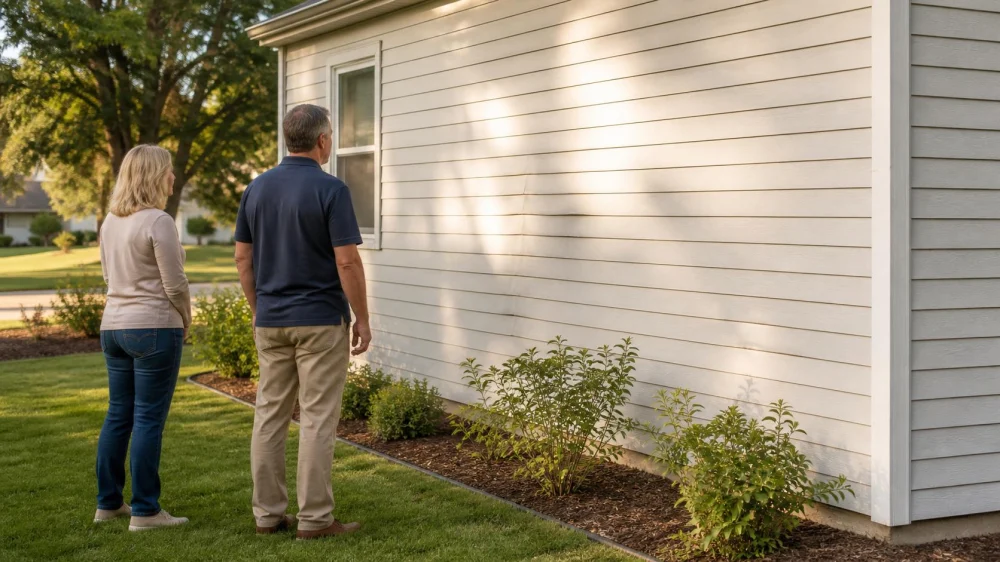
Siding Buckles in Heat: Record Patterns Before Repair
On this page
Quick answer
If siding looks buckled or wavy in hot weather, photograph it from the ground at different times without pushing, prying, or removing panels. Note sun exposure, temperature, nearby windows, grills, vents, fasteners, openings, and moisture clues. Heat expansion, installation clearance, reflected heat, substrate movement, and other conditions can look similar, so a qualified inspection should identify the cause before repair.
Timothy Schaffer Roofing, Siding & Windows
TelfordMontgomery CountyPennsylvania
Undisclosed, Telford, PA 18964, USA
Why heat-related siding waves need diagnosis
Many siding systems need room to move as temperatures change. Visible waves can be associated with tight fastening, insufficient clearances, uneven sheathing, impact, moisture, heat reflected from nearby glass, or normal-looking shadow effects. The correct repair depends on the material, installation details, wall condition, and heat source; replacing one panel without diagnosis may repeat the problem.
This guide is for United States homeowners observing siding from accessible ground-level locations. Vinyl, aluminum, fiber cement, engineered wood, wood, insulated panels, and other products behave differently. Manufacturer instructions, local code, climate, wall design, warranty terms, and installer responsibility should guide assessment and repair.

Clues to record safely
- The siding material if known, approximate installation age, affected wall, direction it faces, and whether the area is above a roof or hard to access.
- Time of day, outdoor temperature, direct sun, shade, wind, and whether the waves lessen after the wall cools.
- Wide and close ground-level photos from the same safe position, including straight trim or corners that show scale and alignment.
- Nearby low-emissivity windows, dark surfaces, grills, fire features, dryer or mechanical vents, exterior lighting, or concentrated exhaust heat.
- Patterns around seams, fastener lines, corners, openings, utility blocks, penetrations, roof intersections, and transitions between materials.
- Moisture stains, soft finishes, peeling paint, odors, interior dampness, insect activity, or recent leaks and storms.
- Installation records, product identification, warranty, prior repair, contractor information, and any recent window, roof, deck, or wall work.
Prepare for a siding inspection
- Mark the observation on a simple wall sketch and take dated photos from the ground without leaning ladders against the affected siding.
- Repeat photos in cooler and warmer conditions when this can be done normally and safely; do not apply artificial heat or water.
- Move portable heat sources such as grills farther away when manufacturer and fire-safety guidance requires it, without altering the wall.
- Check accessible interior rooms for related moisture or finish changes, but do not open walls or remove electrical covers.
- Contact a qualified siding or building-envelope professional and provide the timeline, photos, product records, and nearby heat-source details.
- Ask the inspector to distinguish surface movement from substrate, moisture, flashing, fastening, or reflected-heat issues before pricing repair.
- Document the proposed cause, affected area, repair method, matching limits, permits, warranty effect, and how recurrence will be checked.
Keep original dated photos, weather notes, a wall sketch, product and installation records, window information, previous invoices, inspection findings, repair scope, permits, warranty correspondence, and after-repair images. Preserve the removed panel or label only when the contractor and property conditions allow safe storage.
Limits and safety boundaries
Appearance alone cannot confirm whether the issue is cosmetic or whether weather protection behind the siding is affected. Do not nail through panels, loosen fasteners, cut slots, use a heat gun, pressure wash the area, climb onto roofs, or remove panels without product-specific knowledge. Reflected heat and fire clearances require careful source assessment.
Seek prompt professional help for active water entry, loose panels at risk of falling, fire damage, melted components near electrical or fuel equipment, structural movement, or widespread rapid change. Contact the installer, manufacturer, window professional, siding contractor, building-envelope specialist, insurer, or local authority for questions within that role.
Frequently asked questions
Does wavy vinyl siding always mean it was nailed too tightly?
No. Tight fastening is one possibility, but substrate, clearance, reflected heat, impact, moisture, and visual shadows can produce similar clues.
Why does the siding look worse in the afternoon?
Direct sun and nearby reflected heat can raise surface temperature, but time-of-day photos do not identify the cause by themselves.
Can I push a buckled panel flat?
Do not force it. Pushing can crack, unlock, or conceal the pattern an inspector needs to assess.
Will one replacement panel match?
Color, texture, weathering, profile, and production changes can limit matching. Discuss sample comparison and repair boundaries in writing.
Should a window be checked too?
Yes when the pattern aligns with concentrated reflection or recent window work. Coordinate qualified siding and window assessment rather than assuming either source.
Sources and evidence
Use the siding manufacturer's current installation and warranty instructions, window and appliance guidance for nearby heat sources, installer records, local building and fire information, and findings from qualified siding or building-envelope professionals. Project-specific evidence should determine the repair.
Conclusion and next steps
Photograph the pattern safely, compare normal hot and cool conditions, identify nearby heat and moisture clues, and gather product records. Do not force or remove panels. Ask a qualified professional to document the cause and repair boundary first, especially when water protection, reflected heat, fire clearance, or underlying wall movement may be involved.
 David M. Maines & Associates, Inc.4.0 (8 reviews)
 Home Front Builders Group5.0 (4 reviews)
 McDundee Roof & Exterior Softwashing4.0 (94 reviews)
 Metal Exteriors LLC4.0 (22 reviews)
 Roberts Repairs & Roofing0.0 (0 reviews)
 HomePro of Farmington Valley Inc5.0 (10 reviews)
 Signs Your Roof Is Near the End of Its Lifespan – What to Look Out For
 What to Expect During a Roof Inspection
 What to Expect from a Roof Warranty Claim Process
 Roof Sheathing Replacement: When It Becomes Necessary for Your Home
 How to Improve Roof Performance with Proper Installation
 How to Measure Roof Slope & Its Effect on Water Runoff