
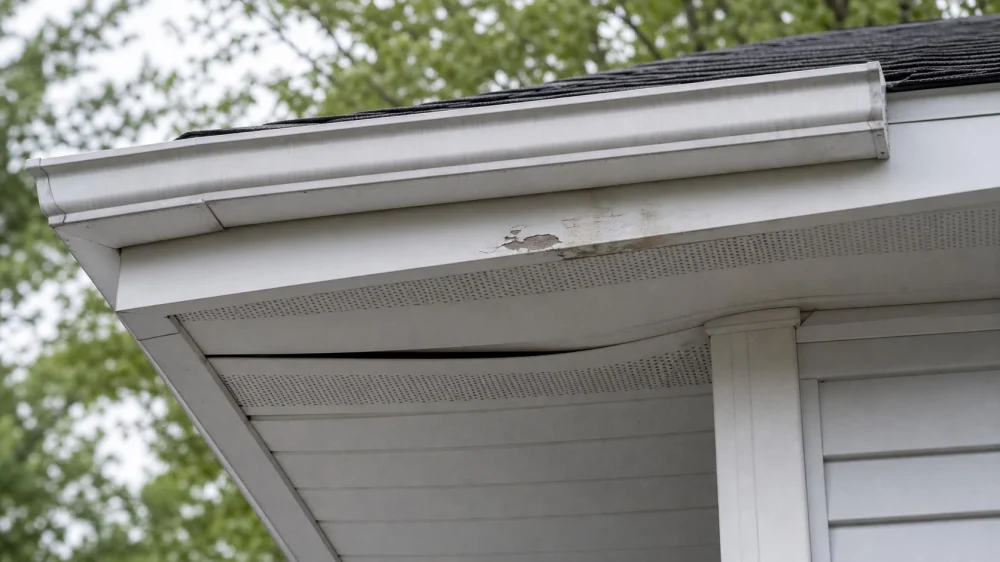
Soffit and Fascia Damage: Signs Homeowners Can Check
On this page
Quick answer
Check soffits and fascia from the ground for peeling finishes, stains, soft-looking edges, open seams, sagging panels, loose gutters and blocked vents. Damage often begins with roof-edge or gutter water, animals, failed coatings or poor ventilation. Do not cover decay with new trim or seal ventilation openings. A contractor should trace the moisture path and inspect the roof edge, gutter attachment and concealed wood before repair.

Kalkreuth Roofing & Sheet Metal Inc.
WheelingOhio CountyWest Virginia
53 14th St #100, Wheeling, WV 26003, USA
What soffit and fascia do
Soffit is the finished underside of a roof overhang. Fascia is the vertical edge board or covering at the roof perimeter, often supporting gutters. Together they protect roof-edge components and create a finished transition between roofing and exterior walls.
Vented soffits may provide intake air for a designed attic ventilation path. Fascia can conceal rafter tails and roof sheathing edges, but it is not meant to compensate for missing drip-edge or flashing details.

Warning signs worth documenting
- Peeling paint, swelling, cracks or dark water streaks.
- Sagging, missing or separated soffit panels.
- Soft, crumbly or distorted fascia edges.
- Gutters pulling away, changing slope or overflowing at one location.
- Rust marks, exposed fasteners or repeated sealant patches.
- Bird, insect or animal entry and nesting material.
- Blocked, painted-over or missing soffit vents.
- Attic dampness, staining, musty odour or frost where climate permits.
Safe ground-level checklist
- Walk the perimeter in dry daylight from stable ground.
- Use camera zoom to photograph each eave, corner and gutter joint.
- Compare stained areas with roof valleys, downspouts and wall intersections above.
- Observe gutter performance during rain from shelter; do not stand below overflow or ice.
- Look for roof-edge shingle damage, displaced metal and debris without climbing.
- Check safely accessible attic areas for matching moisture signs.
- Keep people away if metal, gutter or trim is loose enough to fall.
Best homeowner task: documentation and safe observation. Not suitable for DIY: ladder work, disturbing nests, opening energized soffit fixtures or removing trim that may release concealed material.
Likely causes and diagnostic clues
- Gutter overflow: blockage, poor slope, undersized drainage or loose attachment can wet fascia repeatedly.
- Roof-edge detailing: damaged covering, drip edge, underlayment or flashing may direct water behind the gutter.
- Ice and snow: freeze-thaw and ice dams can force water into vulnerable edge assemblies.
- Condensation: indoor moisture, air leakage and an incomplete ventilation path can affect attic edges.
- Animal entry: an initial gap can expand as birds, rodents or insects use the cavity.
- Material aging: failed coating, corrosion, ultraviolet exposure and joint movement reduce protection.
- Mechanical damage: ladders, branches, storms and poorly placed fasteners can loosen components.
Staining directly below a gutter does not prove the gutter is the only cause. Water can travel along sheathing or framing before appearing at the eave.
Repair decisions
A durable repair follows the source-to-finish sequence: control roof or drainage entry, remove only enough finish to inspect concealed conditions, replace unsound wood or corroded components, restore ventilation and pest exclusion, then reinstall compatible soffit, fascia and gutter details.
- Targeted repair: may suit isolated damage with sound adjacent material and a corrected source.
- Section replacement: may be needed when hidden decay extends beyond the visible mark.
- Broader eave work: may be efficient during reroofing or gutter replacement when edge details are consistently deficient.
- Specialist coordination: electricians, pest professionals or structural repair may be necessary depending on findings.
Do not wrap wet or rotten wood in aluminum or vinyl. Concealment without source control can allow deterioration to continue unnoticed.
Questions for a contractor
- Where is moisture entering, and what evidence supports that path?
- Will the roof edge and gutter attachment be inspected behind the finish?
- How much exploratory removal is included?
- How will damaged sheathing, rafter tails or sub-fascia be priced?
- Will soffit intake area and attic exhaust remain balanced and unobstructed?
- How will animal openings be closed without trapping wildlife?
- Which materials, coatings and fasteners are compatible?
- Will concealed conditions and completed layers be photographed?
Verify applicable licensing, insurance and written warranty terms. Directory listings are useful for discovery but do not replace current credential checks.
Important notes and evidence boundaries
This is general U.S. exterior-envelope guidance. Roof assemblies, wildfire zones, ventilation design, pest rules and local code vary. It is not a structural, mould or indoor-air diagnosis.
Do not disturb suspected asbestos-containing materials, large nests, bats or aggressive insects. Follow local wildlife and hazardous-material requirements and use qualified specialists.
Frequently asked questions
Can damaged fascia cause a roof leak?
Fascia damage can accompany faulty roof-edge drainage, but the water entry may begin above it. The roof edge, drip details and gutter should be assessed together.
Should every soffit panel be vented?
No. Vent layout depends on the attic design and code. Adding or blocking vents without a plan can short-circuit airflow or admit weather.
Can I paint over stained soffit?
Only after the moisture source is corrected, the material is sound and dry, and the coating is compatible. Paint does not repair decay.
Why is my gutter pulling away from the fascia?
Possible causes include deteriorated wood, inadequate fasteners, ice, debris weight or poor drainage. Refastening into unsound material is not durable.
Who repairs soffit and fascia?
Roofing, siding, gutter or general contractors may perform the work. Choose based on the diagnosed source and verify that the scope covers concealed components.
Next steps
Photograph every eave, map stains to roof and gutter features, and note attic or pest signs. Request an inspection that identifies the moisture source before covering or replacing trim. Compare scopes by source correction, concealed repair, ventilation continuity and documented finish details.
 California Building Contracting5.0 (6 reviews)
 MIST Construction4.0 (6 reviews)
 Delaney's Home Services5.0 (16 reviews)
 Copenhaver Roofing3.0 (6 reviews)
 Campos Roofing0.0 (0 reviews)
 Dixie Roofing5.0 (4 reviews)
 Average Lifespan of Asphalt Shingles and How to Extend It
 The Complete Guide to Metal Roofing Systems – Benefits, Materials, and Installation
 Siding Projects That Increase Curb Appeal Fast
 Discover the Environmental Benefits of a Cool Roof for Your Home or Business
 Should I Repair or Replace My Roof? – Expert Guidance on Making the Right Choice
 Top 10 Signs Your Roof Needs Immediate Repair | Roofing Guide for U.S. Homeowners