
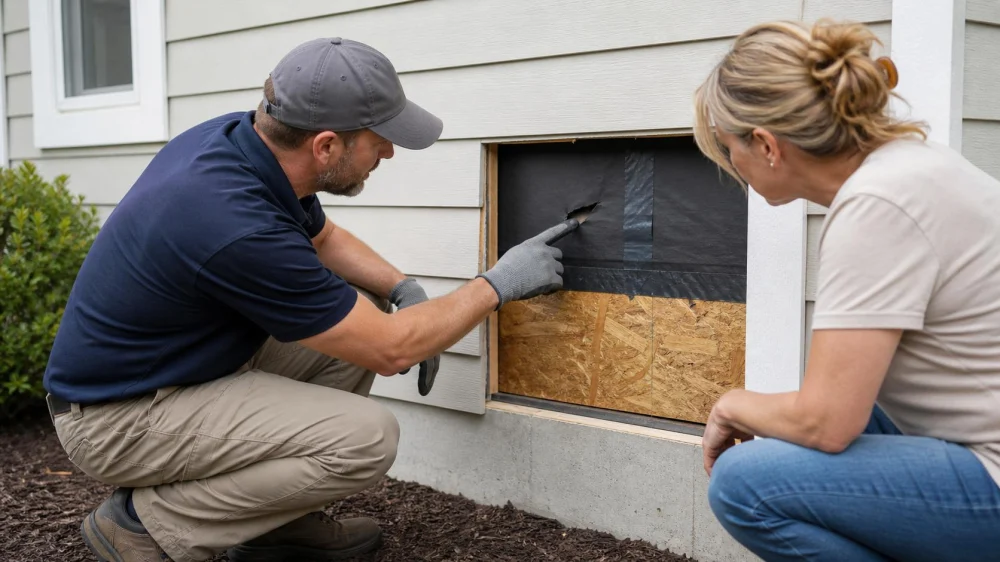
Damaged Siding: Check the Water-Resistive Barrier Behind It
Table of contents
Quick answer
When siding is cracked, punctured, loose, or missing, the repair should address more than the visible panel. Ask the contractor to inspect the weather-resistive barrier, flashing, sheathing, fasteners, and drainage path behind the damaged area. Photograph exposed layers before they are covered and confirm compatible materials, lap direction, seams, and moisture findings in writing.
Home Genius Exteriors
1657 Mentor Ave Suite 203, Painesville, OH 44077, USA
Siding is not the only water layer
Most cladding is designed to shed rain, but some water can pass through joints and openings. A weather-resistive barrier behind the siding acts as a drainage plane that directs this water down and out. Flashing at windows, doors, roofs, decks, and penetrations must integrate with that barrier.
DOE Building Science Education explains that typical siding systems can admit some wind-driven or capillary water and that the barrier, seams, and flashing integration protect the wall cavity. Replacing only the face panel can leave a tear or failed transition hidden.

Ground-level checks
- photograph the damaged panel and surrounding wall from safe ground;
- look for open seams, displaced corners, punctures, and loose accessories;
- check indoors for staining, odour, swelling, or soft trim near the area;
- note the event, wind direction, impact, leak timing, and recent work;
- keep sprinklers and pressure washing away until the opening is assessed;
- do not pull panels away or insert sealant into drainage gaps yourself.
Keep people clear when material could fall. Electrical service, gas equipment, and overhead lines require qualified coordination.
Repair-scope questions
- How much siding must be removed to inspect the full damaged boundary?
- What barrier type is present, and how will tears be repaired with compatible products?
- How will laps direct water outward and integrate with nearby flashing?
- Is sheathing wet, swollen, decayed, or structurally damaged?
- Does insulation or framing need drying or replacement?
- How will replacement panels accommodate movement and match existing courses?
- What permit, manufacturer, or warranty instructions apply?
Document before closing the wall
Request wide and close photos after cladding removal, after barrier and flashing repair, and before new siding covers the work. Record moisture readings with locations and dates, product labels, compatible tapes or membranes, fastener type, and any change order for concealed damage. Final photos should show transitions, trim, sealant locations, and drainage openings.
Limitations
Wall assemblies differ by climate, age, code, cladding, and retrofit history. Housewrap, felt, coated sheathing, liquid membranes, rainscreens, and masonry systems require different repairs. A surface moisture reading or indoor stain does not define the full damage. Qualified inspection may require selective removal.
FAQ
Can one cracked panel be replaced alone?
Sometimes, but the contractor still needs to assess whether impact or water damaged layers behind it.
Should every gap be caulked?
No. Some gaps and weep paths are intentional. Follow the siding and flashing system instructions.
What if the housewrap is torn?
It should be repaired with a compatible, correctly lapped method before the wall is closed.
Can matching siding be found?
Availability, lot colour, profile, and weathering affect the match. Save product identifiers and discuss an intentional transition if exact material is unavailable.
Sources and evidence notes
- U.S. DOE Building Science Education: Water-Managed Walls — cladding leakage, drainage planes, barriers, and flashing integration.
- U.S. DOE Building Science Education: Housewrap — seam sealing, fasteners, openings, and flashing.
Next steps
Photograph the damage, prevent additional wetting without blocking drainage, and ask a siding professional for a layered repair scope. Require photos and moisture findings before concealed wall components are covered.

 American Home Remodeling4.0 (282 reviews)
 Jacob E. Allen Roofing3.0 (11 reviews)
 All Pro Handyman and Roofing5.0 (2 reviews)
 4 Guys Roofing LLC5.0 (12 reviews)
 Precise Painting Enterprises Inc.5.0 (76 reviews)
 Pablo paints5.0 (5 reviews)
 Should I Repair or Replace My Roof? Key Considerations for Homeowners
 Why Hiring Licensed Roofing Contractors Protects Your Investment
 Roof Maintenance in Urban Environments: Challenges & Tips
 How to Prevent Moisture Damage from Roof Leaks Effectively
 The Importance of Hiring Experienced Roofing Professionals for Long-Term Protection
 Top Questions to Ask a Roofing Contractor Before Hiring