
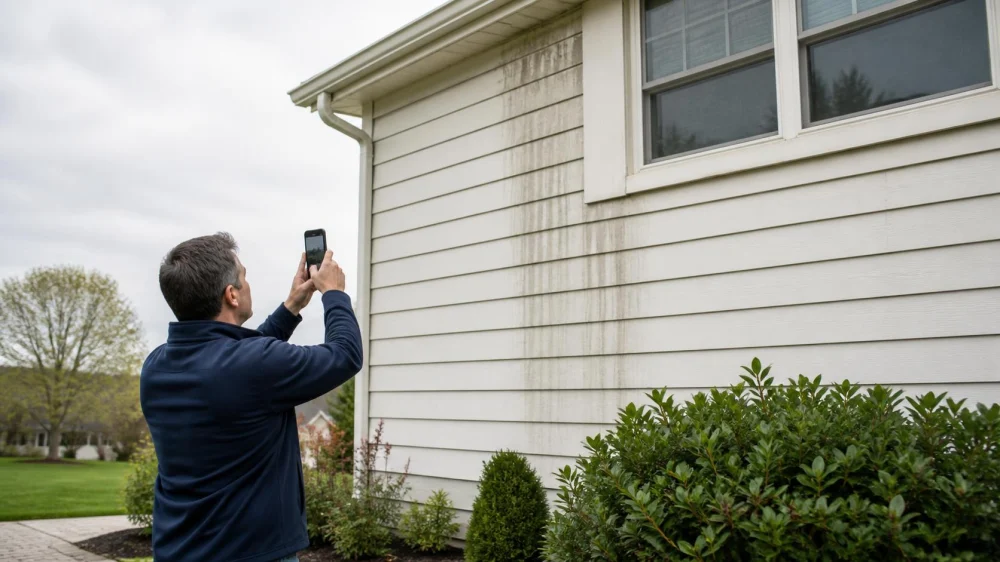
Siding Water Streaks: Trace the Source Before Cleaning
On this page
Quick answer
Before cleaning streaks on siding, photograph their shape and note what is directly above: gutters, roof edges, windows, vents, fixtures, trim, or another material. Observe during rain from a safe ground location. Correct uncontrolled water, leaks, corrosion, or incompatible runoff before washing the surface. Use only the siding manufacturer’s approved low-pressure cleaning method, and test a hidden area first.
Do not pressure-wash upward into laps, climb a wet ladder, or seal over drainage openings. A clean wall can still have an unresolved moisture path.
Read the pattern
- Vertical line below a joint: water may be concentrated by trim, a seam, or a penetration.
- Broad band below an eave: gutter overflow, roof runoff, or splash may be involved.
- Marks beneath a window corner: drainage, sealant, flashing, or condensation paths need assessment.
- Rust-colored streak: metal corrosion or fasteners may contribute.
- Dark or green film: persistent shade, moisture, dirt, algae, or biological growth may be factors.
- White residue: mineral deposits or material movement may be involved.
Color and location provide clues, not a diagnosis. The same appearance can have several causes.
Ground-level checks
- Photograph the full wall elevation in dry weather.
- Take close images with a safe reference for scale.
- Use zoom to record roof edges, gutters, windows, and penetrations above.
- Observe runoff during moderate rain from indoors or a protected location.
- Check downspout discharge and soil splash at ground level.
- Look for loose siding, open trim joints, damaged caulk, and corrosion without touching.
- Check accessible interior surfaces for stains, odor, peeling finish, or dampness.
Do not remove siding, trim, vents, or fixtures to investigate.
Possible sources
Streaks may result from ordinary dirt, roof or gutter runoff, sprinkler spray, missing kick-out flashing, poorly directed downspouts, window drainage, sealant failure, siding installation details, roof-to-wall interfaces, fastener corrosion, or runoff from masonry and metal.
Landscaping and grading can add splash-back. A contractor should consider the route from the highest possible source to the final discharge point rather than treating only the visible mark.
Cleaning limits
Identify the siding product and finish before choosing cleaner, brush, water temperature, or pressure. Vinyl, fiber-cement, engineered wood, metal, and wood siding have different instructions. Protect plants, people, openings, electrical fixtures, and adjacent finishes.
Do not mix cleaners, use abrasive pads, scrape coatings, or apply bleach or solvent without explicit product guidance. High pressure can drive water behind cladding, damage finish, and enlarge gaps. Rinse in the direction the manufacturer specifies.
When to call a contractor
Arrange evaluation for recurring streaks, interior moisture, soft or swollen material, loose panels, open flashing, rust, damaged trim, water behind the siding, or staining linked to rain. Ask whether roofing, gutters, windows, cladding, and wall drainage need coordinated review.
Request photographs, moisture findings when relevant, the source diagnosis, product-compatible repair, and a written scope. Cleaning should be separate from repairs needed to control water.
Build a useful record
Save dated dry-weather and rain photographs, rainfall direction, sprinkler schedule, cleaning history, siding product, installation age, warranty, and past repairs. Mark whether the stain returns and how quickly.
If a cleaner is used, record the product, dilution, test location, method, contact time, and result. This helps prevent repeated experiments that damage the finish.
Frequently asked questions
Are dark streaks always mold?
No. Dirt, algae, runoff, and material changes can look similar. Avoid guessing.
Can I use a pressure washer?
Follow the siding manufacturer’s instructions. High pressure and upward spray can cause damage and water entry.
Should I caulk every gap?
No. Some gaps and openings are required for drainage or movement. Get product-specific advice.
Why do stains return after cleaning?
The water or contaminant source may remain, or the cleaning method may not match the material.
Can gutter overflow stain siding?
Yes. Roof drainage and splash can carry dirt or minerals down the wall.
Sources and evidence notes
This guide uses building-envelope water-path analysis and material-compatible cleaning principles: document before altering, trace from above, preserve drainage, and follow product instructions. Exact details vary by cladding, wall system, climate, and jurisdiction.
Use siding manufacturer guidance and qualified roofing, gutter, window, or siding professionals for the specific property.
Conclusion and next steps
Photograph the pattern before it disappears, look upward for the water path, and compare dry and rainy conditions. Correct runoff or enclosure defects first, then clean with the approved low-pressure method. If the streak returns or interior moisture appears, request a coordinated exterior inspection rather than escalating cleaning strength.






 Affordable Gutter Guy Seamless Gutter Installer5.0 (69 reviews)
 J&M Roofing4.0 (58 reviews)
 Cobblestone Construction4.0 (36 reviews)
 A quality roofing1.0 (1 reviews)
 SIPM Roofing4.0 (79 reviews)
 Carter & Sons Roofers LLC4.0 (53 reviews)
 Why Professional Roof Inspections Are Worth the Cost: Expert Insights
 Roof Performance Comparisons by Material & Climate
 How to Budget for a Roof Replacement Project: Step-by-Step Guide for Homeowners
 How Long Does a Roof Replacement Take from Start to Finish?
 Should I Repair or Replace My Roof?
 Role of Roof Sheathing Moisture Barrier