
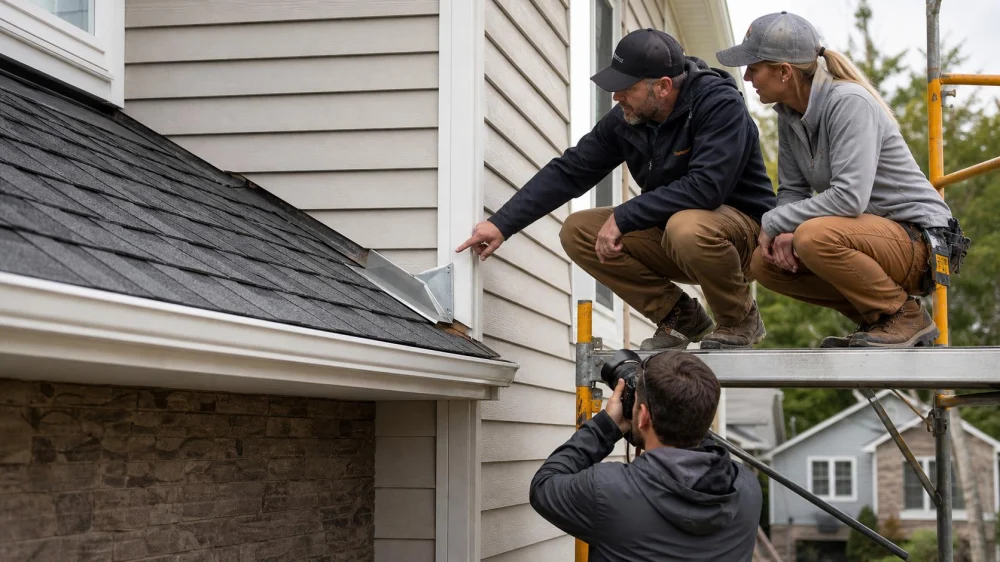
Kickout Flashing at Roof-to-Wall Corners: Send Water to the Gutter
On this page
Quick answer
Where a sloped roof ends against a wall, kickout flashing should direct runoff away from the siding and into the gutter. From the ground, look for water streaks, rot, staining, missing or undersized diverters, gutter gaps, and patched sealant. Do not climb or bend flashing yourself. Ask a qualified roofer and siding contractor to document how step flashing, water-resistive barrier, kickout, gutter, and wall finish overlap as one drainage path.
Tip Top Roofing Inc.
Moreno ValleyRiverside CountyCalifornia
26589 Ironwood Ave, Moreno Valley, CA 92555, USA
Why it matters
A small roof-to-wall corner can collect a large volume of runoff. If water slips behind cladding, damage may spread through sheathing, framing, insulation, and interior finishes before it becomes obvious.
This United States guide is general. Codes, manufacturer details, roof material, cladding, rainfall, gutter design, and existing construction vary. The correct assembly must follow applicable instructions and verified field conditions.

Practical checklist
- Observe during or just after rain from a safe ground position.
- Photograph the roof edge, wall corner, gutter end, siding below, and interior stains.
- Note overflow, splash, streaks, soft trim, peeling paint, insects, or recurrent caulk repairs.
- Ask which contractor owns roofing, flashing, gutter, siding, and concealed-wall scope.
- Require a detail showing water-resistive barrier and flashing laps.
- Include damaged sheathing and framing as a priced change-order process.
- Request concealed-work photos before siding or roofing covers the repair.
Step-by-step plan
- Map the water path from roof plane to gutter without climbing.
- Check whether gutter placement can receive diverted water and whether the downspout handles the flow.
- Have qualified contractors open only the area needed to inspect step flashing, barrier laps, sheathing, and decay.
- Compare the repair with roof and siding manufacturer details and local code requirements.
- Coordinate replacement layers from the drainage plane outward rather than relying on face sealant.
- Test drainage using an approved controlled method after assembly, avoiding high-pressure hose misuse.
- Document completion and monitor the corner during later storms.
Keep rain videos, prework photos, roof and siding product data, contractor roles, drawings, concealed-condition photos, change orders, moisture findings, invoices, and warranty updates.
Limits and warning signs
Surface caulk cannot reliably replace correctly integrated flashing. Visible staining does not reveal the full concealed damage, and an oversized diverter can still fail if barrier laps or gutter placement are wrong.
Use urgent help for falling material, electrical water contact, significant structural decay, active interior flooding, or unsafe access. Environmental assessment may be needed for extensive concealed microbial growth.
Frequently asked questions
Can I add caulk at the corner?
Do not treat caulk as the drainage system. The flashing and water-resistive barrier must overlap correctly behind the cladding.
Who repairs kickout flashing?
Roofing and siding scopes overlap. Assign one lead and document each contractor's responsibility.
Must siding be removed?
Sometimes limited removal is needed to inspect and integrate the barrier. The contractor should explain the access plan.
How can I check it safely?
Observe runoff from the ground during rain and request contractor photos; do not climb.
Sources and evidence
The article reflects common building-envelope practice: shingle drainage layers, integrate step and kickout flashing with the wall barrier, discharge into the gutter, inspect concealed materials, and document before cover-up.
Conclusion and next steps
Photograph the corner during rain, then ask roofing and siding contractors for one coordinated drainage detail. Approve work only when flashing, barrier, gutter, concealed damage, and closeout photos are included.






 RedStorm Projects | Roofing & Construction4.0 (10 reviews)
 J & B Gutters & Remodeling Inc.4.0 (6 reviews)
 Houston Commercial Roofing and Construction4.0 (18 reviews)
 Texas Roofing & Leak Repair4.0 (205 reviews)
 Stallion Roofing & Solar Solutions4.0 (103 reviews)
 Ejc Home Improvement Corp5.0 (15 reviews)
 The Pros and Cons of Vinyl Siding: Is It the Right Choice for Your Home?
 How to Choose Roof Material Based on Snow Load: Essential Tips for Winter Protection
 How to Choose a Reliable Roofing Contractor Near You: A Step-by-Step Guide
 How to Choose the Right Fasteners & Flashing for Your Siding Type
 How Much Does a New Roof Cost in 2025?
 Roofing Underlayment Replacement: When It’s Necessary | Roofing Tips