
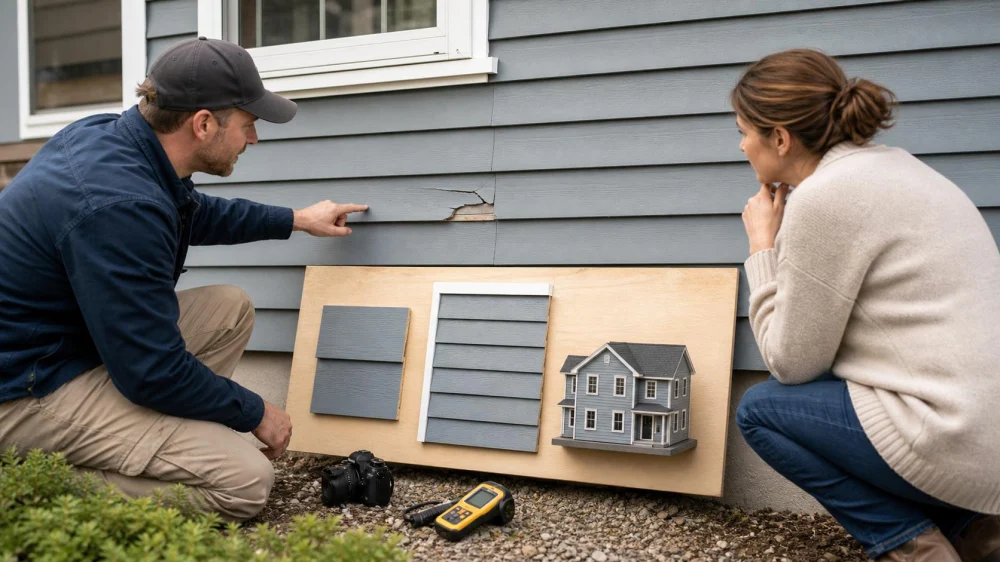
Siding Repair or Replacement? A Homeowner Decision Guide
On this page
Quick answer
Repair siding when damage is localized, matching material is available, underlying sheathing and flashing are sound, and the patch can preserve drainage. Consider replacing a wall section or the whole exterior when damage is widespread, repeated leaks exist, panels are brittle or obsolete, coatings fail broadly, or access and setup make repeated repairs inefficient. Inspect behind representative damaged areas before deciding.

Online Roofing Windows & Siding of Warren
WarrenSomerset CountyNew Jersey
174 Mt Bethel Rd, Warren, NJ 07059, USA
Define the three options
A siding repair replaces or corrects a limited area while retaining most cladding. Elevation replacement renews one complete wall face. Whole-house replacement renews all elevations and allows more consistent water-management and appearance work.
These are not merely cosmetic choices. The scope must preserve or restore the water-resistive barrier, flashing, fasteners, clearances, and drainage path behind the visible siding.

When a limited repair may fit
- A few panels are cracked, loose, dented, or wind-damaged.
- The cause is known and corrected.
- Adjacent siding remains flexible, secure, and serviceable.
- Matching or acceptably compatible material is available.
- Sheathing and framing are dry and sound.
- Flashing can be integrated without dismantling a large wall area.
- The product warranty and installation instructions permit the proposed method.
Best for repair is a discrete, accessible defect with a clear stopping point. A small visible spot is not ideal for repair when moisture has travelled widely behind it.
When replacement may fit
- Cracking, warping, rot, delamination, corrosion, or coating failure occurs across many panels.
- Leaks recur at windows, roof-wall joints, decks, or penetrations.
- The original siding is discontinued, brittle, or difficult to remove intact.
- Fastening or clearances are systematically incorrect.
- Sheathing repair requires broad access.
- Multiple future repairs would repeat scaffolding, mobilization, trim, and painting costs.
- A planned insulation or window project requires rebuilding exterior details.
Replacing one elevation can be a useful middle option when exposure created concentrated damage and transitions at corners can be detailed cleanly.
Check for hidden wall damage
Staining, soft trim, swollen panels, musty odour, indoor paint damage, insect activity, and repeated caulk failure can indicate concealed moisture. Water may enter above or beside the visible symptom and travel along sheathing.
Ask for non-destructive moisture checks and selective removal at representative areas. The contractor should photograph the water-resistive barrier, flashing, sheathing, framing, and insulation before covering them. Structural decay, mould, lead, or asbestos can require specialists.
Material and colour matching
Even the same product colour can differ after years of ultraviolet exposure, dirt, and weather. Obtain a physical sample and view it on each elevation in daylight. Also match profile, thickness, exposure, texture, locking geometry, and fastening requirements.
When an exact match is unavailable, use a deliberate boundary such as an inside corner, outside corner, trim band, or complete elevation. Scattered near-matches can look less intentional than a coordinated contrast.
Compare the full scope
- Access, protection, scaffolding, permits, and mobilization.
- Removal, disposal, and hazardous-material testing.
- Sheathing, framing, insulation, and water-resistive barrier allowances.
- Window, door, deck, roof-wall, and penetration flashing.
- Siding, trim, fasteners, sealants, paint, and cut-edge treatment.
- Utility fixtures and equipment removal and reconnection.
- Interior repairs caused by confirmed leakage.
- Photos, inspections, cleanup, warranties, and maintenance instructions.
Compare a five- or ten-year repair plan, not only today’s invoice. A larger project may reduce repeated setup costs, while a sound localized repair avoids unnecessary removal.
Inspection checklist
- Map every damaged area by elevation.
- Identify the cause, not only the symptom.
- Check windows, doors, roofs, decks, meters, vents, and ground clearances.
- Measure moisture where appropriate and document representative openings.
- Confirm product identity and availability.
- Request repair, elevation, and whole-house alternatives when reasonable.
- Require written assumptions and unit prices for concealed damage.
- Confirm how drainage remains continuous at repair boundaries.
Limitations and safety notes
This guide cannot determine structural condition from photographs or price a project across all U.S. markets. Wind, wildfire, flood, coastal, historic-district, and energy-code requirements can change the suitable scope.
Do not climb walls or remove siding around electrical service, gas equipment, unstable assemblies, or suspect hazardous materials. Active structural movement, sparking, gas odour, or falling cladding requires immediate professional or emergency help.
Frequently asked questions
Can one damaged siding panel be replaced?
Often, if the system permits disassembly, the match is compatible, and underlying layers are sound. Brittle or interlocked products may require a larger area.
Will insurance pay for matching siding?
Coverage depends on the policy and state law. Document product availability and damage, then ask the insurer in writing; do not rely on a contractor’s guarantee.
Can new siding cover damaged siding?
Covering can hide leaks and decay. Code, manufacturer instructions, flatness, attachment, flashing, and wall drying must support any overlay.
Should windows be replaced at the same time?
Not automatically. Coordination can improve flashing access, but sound windows may remain if the new drainage details integrate correctly.
Sources and evidence notes
The decision framework follows the broad building-science principle that all claddings require a continuous drainage plane and integrated flashing. U.S. Department of Energy Building America wall guidance supports evaluating cladding as part of the whole wall assembly.
Next steps
Photograph and map damage, then request an inspection that identifies cause and opens representative areas when justified. Ask for three written scopes—limited repair, elevation replacement, and whole-house replacement—where feasible, and compare drainage continuity, concealed work, matching, maintenance, and long-term cost.
 Coastal G. A. Roofing, LLC4.0 (12 reviews)
 All Access Builders LLC4.0 (128 reviews)
 Dedicated contracting services0.0 (0 reviews)
 Richards Building Supply4.0 (15 reviews)
 Katy Roofing & Remodeling4.0 (19 reviews)
 LaMaison Construction, Inc.3.0 (4 reviews)
 How to Spot Roofing Issues Before Major Repairs Are Needed
 How to Minimize Roof Noise: Material & Installation Tips
 How to Choose Roofing Materials for Long-Term Protection
 What to Expect During a Roof Inspection: A Comprehensive Guide
 Flat Roof vs Sloped Roof: Pros, Cons & Typical Costs
 Siding Styles That Compliment Your Home's Architectural Era